Passing a school vision screening doesn’t tell the whole story about your child’s eye health. Discover how a comprehensive eye exam checks beyond distance vision to assess focusing, eye coordination and overall eye health.
As a parent, your child’s health and development are your top priorities. When a new school term begins, checking off items on the school list usually includes uniform fittings, textbook shopping, and perhaps a quick school vision screening.
If your child passes that basic screening, it is easy to assume their eyes are perfectly healthy. However, relying solely on a school screening can leave a massive gap in your child’s healthcare.
Here is why a comprehensive eye exam is essential for your child’s academic success and long-term well-being.
The Reality of School Screenings
School vision screenings are fantastic tools for identifying major, obvious vision problems, such as severe nearsightedness. However, they are fundamentally limited.
Most school screenings only test visual acuity—how well a child can see a stationary chart across a room (often called the 20/20 test). While seeing clearly at a distance is important, it represents only a fraction of how a child uses their eyes in a classroom setting.
The Critical Vision Skills Missed by a Screening
Learning doesn't just happen at a distance. It happens at the desk, on a tablet, and while interacting with peers. A basic screening completely misses several vital functional vision skills:
Eye Tracking: The ability of the eyes to smoothly follow a line of text across a page without skipping words or losing place.
Eye Teaming (Binocular Vision): How well both eyes work together as a team. If the eyes do not align perfectly, the brain receives conflicting images, leading to double vision or severe fatigue.
Focusing Flexibility (Accommodation): The ability to quickly shift focus from looking at the teacher at the front blackboard to looking down at a notebook on the desk.
Visual Perception: The ability to understand and organize what is being seen, which is crucial for recognizing letters, shapes, and numbers.
The Great Masquerade: Vision Issues Mistaken for Behavior Problems
Children rarely complain about vision issues because they simply do not know what "normal" sight looks like. They assume everyone sees the blurry letters or experiences the headaches they do.
When a child struggles to focus, look at a book, or track text, they often develop coping mechanisms or exhibit behaviors that are easily misinterpreted. Undiagnosed vision problems are frequently mistaken for:
Learning Disabilities: Struggling with reading compression or falling behind in writing.
ADHD or Behavior Issues: Fidgeting, acting out, or losing focus quickly during desk work because their eyes are physically exhausted.
Lack of Interest: Avoiding reading, drawing, or playing sports entirely.
The Long-Term Impact of Early Detection
Some childhood eye conditions, like strabismus (turned eye) or amblyopia (lazy eye), are highly treatable when caught early while the brain's visual pathways are still developing. Waiting until a child is older can make these conditions much more difficult to correct.
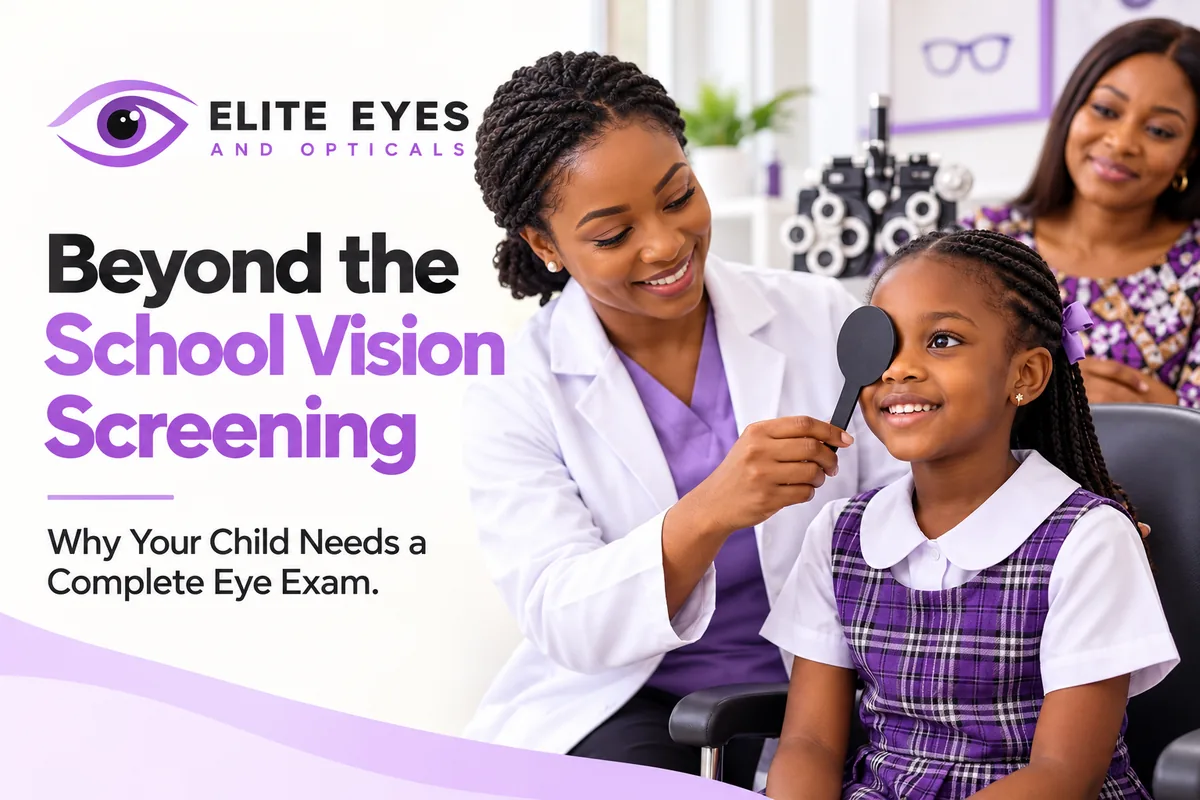
A comprehensive pediatric eye examination evaluated by an eye care professional looks beyond the chart. It checks the physical health of the interior and exterior of the eye, tests how the eyes move together, and ensures your child has the visual tools they need to thrive.
Give Your Child the Best Start
Vision is responsible for roughly 80% of all learning during a child's first twelve years. Ensuring their eyes are functioning perfectly is just as important as providing the right textbooks.
Is your child struggling to focus or complaining of headaches after homework? Don't rely on a simple pass/fail screening. Schedule a comprehensive children’s eye exam at our clinic today to give them the clear future they deserve.
To contact us for more enquiries or to book an appointment, click here.